The price of demolition and strip-out works
You will not find a price list here. You will find a list of the things that push the price up and down, and the questions to ask before you sign a quote.
Why there are no prices here
Because they would be useless. Demolition is priced by volume, not by the square metre of footprint, and two houses with the same footprint can differ twofold in volume. On top of that come machine access, the distance to the disposal site, the type of waste and what has to remain on the plot afterwards. A figure someone sends you without a site visit is either worthless or inflated enough to cover everything. Either way it costs you time.
The second thing: a price without a breakdown is a trap. The difference between two quotes is usually in what is missing from them, not in the rate per cubic metre.
What goes into the price
- Volume. How many cubic metres of structure have to go. That is why demolition is priced per cubic metre, not per square metre of footprint.
- Structural material. Brick, stone, concrete, reinforced concrete, precast panels. Rebar in concrete makes both the work and the haulage dearer.
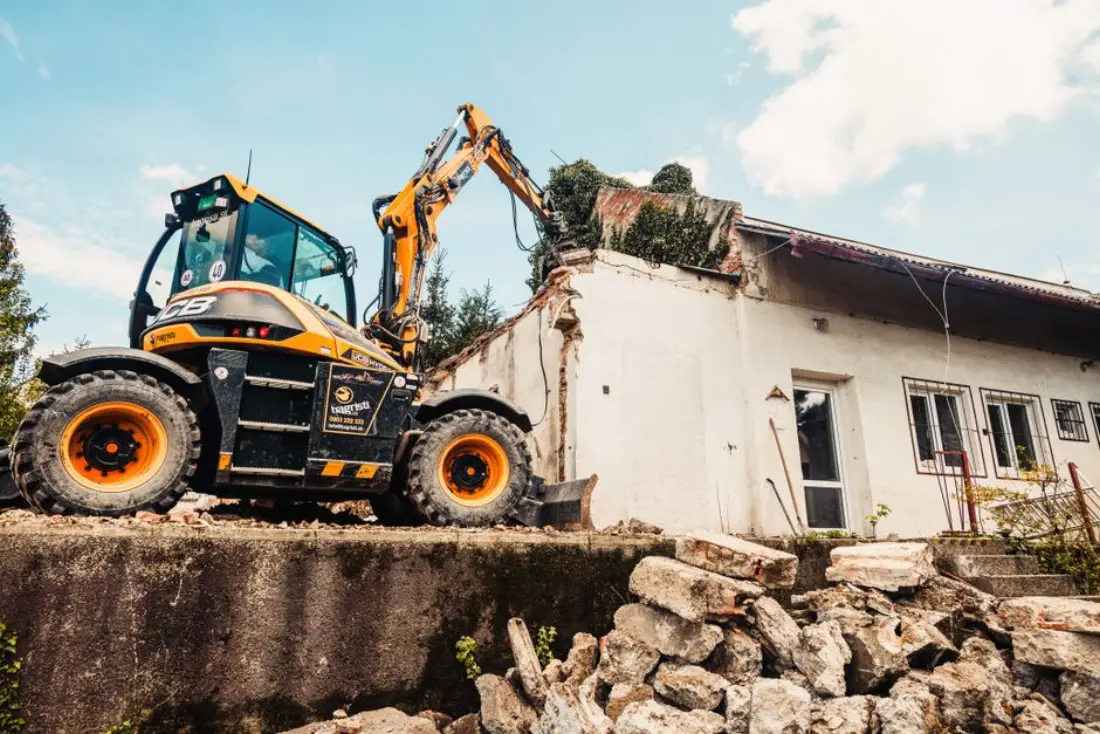
- Machine access. Whether an excavator and a skip can reach the building, or whether it comes down by hand and the rubble is carried out.
- Distance and type of disposal site. How far the rubble travels and whether it is sorted or mixed. Mixed waste costs more to dispose of.
- Asbestos and hazardous waste. A different regime, a different company, a separate line in the quote.
- What is left behind. Foundations out, or left in place? Backfill, compaction, levelling. This is the item quotes most often leave out and invoice later.
- By hand versus by machine. Hand work is counted in hours and people, machine demolition in cubic metres and machine hours.
- Timing and season. A job squeezed between others costs differently from one where the company can pick its week.
What to ask about in a quote
| Question | Why ask it |
|---|---|
| Is debris removal and disposal included? | The most common difference between a cheap and a dearer quote. Waste disposal can be a bigger item than the demolition itself. |
| Will I get a waste transfer document? | The only paper proving where the rubble went. A company that does not offer it may not give you one at all. |
| What happens to the foundations? | Break them out or leave them? The price differs considerably and this is the item quotes miss most often. |
| Is levelling and backfilling included? | A demolition leaves a hole. Who fills it and with what should be agreed in advance. |
| Who arranges the permit and the documentation? | The designer and the application are the owner's business. Some companies can arrange it, but then it belongs in the quote as an item. |
| What if asbestos or other hazardous waste turns up? | How it will be handled and who pays should be agreed beforehand. This is the most common reason for a contract amendment. |
| Does the price hold if access is difficult? | A narrow street, soft ground, occupying the pavement. All of it changes the equipment and therefore the price. |
Frequently asked questions about the price
How can I compare prices roughly on my own?
Work out the volume: built-up area times the height of the structure including the cellar. Then compare two quotes on the same volume and the same scope (with or without foundations, with or without haulage). Otherwise you are comparing two different jobs.
Why is hand demolition calculated differently?
Because you pay for people's time, not for a machine's output. An hourly rate makes sense for interiors and small volumes, volume pricing for machine demolition. If someone offers hand demolition per cubic metre, ask what happens if the estimate is out.
Are there grants for demolition?
For some types of buildings and programmes there can be, but the conditions change and differ by region and by what the plot is for next. We will not promise you amounts we do not know. Check the current conditions with the grant provider.
Tell us what needs to come down
The address, a few photos and one sentence about what has to go is enough. We go through the enquiry and pass it to a demolition company that works in your area. If we have no partner there, we say so straight away instead of leaving you waiting.
- Photos from outside and inside say more than a description. A phone camera is fine.
- Tell us whether machinery can reach the building, or whether it has to come down by hand.
- If you suspect asbestos (corrugated cement sheets, old pipe lagging), say so right away.
Prefer the phone? 775 654 443.